Tuesday, March 5, 2013

雛祭


Every year, on March third, Japan celebrates Hinamatsuri. In English we call it either Girl's Day or Japan Doll Festival; the kanji in the title means "doll festival". The tradition of Girl's Day began in the Heian period of Japanese history, which ran from 794 to 1185 AD. It was believed during this time that dolls had the power to posses bad spirits and so a custom developed called hina-nagashi, translated as "doll floating", in which the dolls would be put in a small boat and floated down the river to the sea, taking the bad spirits with them.

Today, it is a day to celebrate girls and young women. As they grow up, girls collect the dolls as gifts, and show them off on a red, terraced display in the days leading up to March 3rd. The top two dolls are the Emperor and Empress and then the court is below them. You can see examples in the pictures below. Kimonos are worn and special sweets and sushi are eaten, with a special white sake to drink. There is a superstition that if the dolls are left up too long after March 3rd, the longer it will be before the girl gets married, and the faster they are taken down the faster the girl will get married!


The Emperor and Empress; the woman on the tier below are court ladies
Laura, Morgan, and I had the great luck to be invited to a Girl's Day celebration that the ladies of the YWCA were throwing for international college students at Kumamoto's Cultural Center. Sadly, Morgan was unable to attend. I was attending Oe Church that morning and rushed to meet up with Laura before walking downtown. We were greeted cheerfully by the women of the YWCA and by our beloved Tawara-san. Tawara-san is part of the J-3 care committee here in Kumamoto and she and her husband are active in the church community. She has helped us so much since we arrived.

Laura and I were herded into the next room, which held a flurry of activity! So many young foreign women being besieged by Japanese matrons, throwing themselves into the task of getting us all into kimono. Do you know the scene in the Disney movie Mulan when she's getting dressed to go to the matchmaker, and she is just standing on the stool with her arms out, while her mother and grandmother run around her, and silk is flying everywhere? That's basically it, only kimono and I didn't have a stool to stand on.

Dressing in a kimono is no joke. It takes a long time, and all you can do is stand there with your arms out as you are dressed in multiple layers, and the layers of your obi (the piece around the middle) are tightened repeatedly. Often when they would pull to tighten it, they would pull so hard I would stumble forward as my heels lifted off the ground! This was often followed by laughter and checking repeatedly to make sure I was okay. I would take an obi over a corset in a heartbeat, but it is pretty darn tight and limits your movement immensely.

Tawara-san helped Laura and I pick out which kimono we wanted to wear, and then it was off to hair and makeup! Hair is worn up when you wear a kimono, so I had come prepared, but other girls were sitting there having their hair pulled up in beautiful arrangements, complete with large flower pins. After that, we waited some more before being ambushed ourselves!

I love wearing kimono. I feel more like a princess in a kimono than I did in any prom or bridesmaid dress. It is so elegant, so regal, so stately. Kimono just makes you feel beautiful. Happily, Laura caught some pictures of the ladies putting the finishing touches on my obi.


After we dressed, we moved back out into the hall to join the other ladies. There were some young gentlemen in attendance and they looked very dashing in the traditional men's kimono. We had a short tea ceremony and then we headed outside to get our pictures taken. It was funny to see the expressions of the Kumamoto citizens walking by, as all these foreigners in kimono came out of the center.

Walking in kimono is tricky. One of our new friends, Maria, put it this way "Walk like a bear, with your feet pointed in as you take a step forward. The kimono is a cylinder so you have to walk more circularly". This means no striding forward and you shuffle more than you actually pick your feet up. I'm sure I looked pretty funny as I tried to move like I usually do; it simply was not working and I am not good at the whole small, graceful steps thing.


We finished our pictures and got to know some new friends before listening to a young man from China play Japanese folk songs on a traditional two stringed Chinese instrument. It was a beautiful sound! When he finished (and we encored) it was time to learn traditional Japanese dance. Sadly I have no pictures. You will have to trust me when I tell you that it was highly entertaining. I am not a good dancer and there was Laura, counting off and doing wonderfully. I can say with pride that I got it by the end, although I had accidentally thrown my baton (yes, we were dancing with batons) and hit the girl in front of me. She was very gracious about it though!


Then, sadly, the magic was over, and it was time to change back into my American street clothes. I was back to myself, but have the pictures to prove, for one afternoon, I was someone else entirely.

One last scene from Girl's Day; one of my favorite moments that day. As we were headed out to dinner after the international church service we passed a young girl, probably about five or six, in a bright red kimono. She had what looked like her dad's black scarf, bulky around her neck, and she was rubbing her eyes with one hand while holding onto her mother with her other. They were waving goodbye to a woman that I can only assume was her grandmother, also in kimono, as she climbed into a taxi. It was a quick snapshot in time of three generations of Japanese women, all in beautiful kimono. Happy Hinamatsuri everyone! 


Saturday, March 2, 2013

What Culture Shock Means to Me

I woke up yesterday in tears. I had just had a dream. It was a simple dream really. Mom, Claire, Anna, and I were in the kitchen of the house I grew up in. We were around the island counter baking chocolate chip cookies. Dad came home and insisted on "testing the quality" as is his dad duty. I don't even remember what the discussion in the dream was, because it was simple, day to day conversation. And then I woke up alone in my apartment, 6,552.8 miles away from that kitchen and the family I love so very much.


Dictionary.com describes culture shock as, "a state of bewilderment and distress experienced by an individual who is suddenly exposed to a new, strange, or foreign social and cultural environment." We were told in orientation that culture shock would set in about month three, then we would get over it for a time, before it would return in month six. For this reason the Global Missions at the ELCA strongly recommends that we stay in Japan for our first full year, without returning to the United States, in order to overcome this hurdle. Of course, like most mental stresses, culture shock affects everyone differently. That is never more evident than when Morgan, Laura, and I are sitting around at say dinner or a coffee shop and discussing our thoughts on the matter. I won't betray their confidence in detailing their reactions, but I will detail mine below.

Before I begin I should insert a disclaimer. I love Japan. I am having so much fun and every day is a new adventure. I have discovered wonderful friends, fabulous food, and an incredible culture and history here. However, culture shock affects everyone thrown into drastically different situations, whether you move from the country to the city, or across the world. I now have an incredible empathy for those moving to the United States for the first time. How overwhelming it all must be!

So to begin....

What Culture Shock Means to Me:
  • vIt means incredible and gut wrenching homesickness. For anything and everything about home, but most importantly a desperate desire to be hugged by my family.
  • v  It means immediately looking around whenever I hear someone speaking English.
  • v  It means constantly watching all the people around me to discover what I am supposed to be doing, whether I am at the dressing room in the mall (do you take off your shoes or don't you?), or at a tea ceremony.
  • v  It means I would kill for a steak and mashed potatoes.
  • v  It means looking forward to being crazy busy once we start teaching so that I will have less time to stew about things.
  • v  It means being incredibly self conscious about what I look like when I leave the apartment because I know I stand out in a crowd.
  • v  It means that in order to be polite, I have to do things that in Nebraska would be rude. Like not making eye contact and saying hello to random people that I meet, in say, the elevator. This isn't always true of course, and I have had several strangers strike up conversation, but in general I try to respect that space.
  • v  It also means struggling to be polite in general. I say "thank you" and "excuse me" a great deal, because there are different ways to say "Please" and "I'm sorry" and I'm not always sure which is which.
  • v  It means that I can get Mexican food, Chinese food, and Italian food, but it is Japanese Mexican food, Japanese Chinese food, and Japanese Italian food. The thought of American Mexican food, American Chinese food, and American Italian food makes me drool.
  • v  It means asking that God explain why He decided to send me to a foreign country where I do not speak the language.
  • v  It means going to karaoke and belting out all my favorite English songs listed, while dancing around like a madwoman.
  • v  It means putting on my headphones and running till my legs wobble.
  • v  It means that some days I really don't want to leave my apartment because it's my own personal 25.29 meters of American soil. Like the Embassy. Only smaller.
  • v  It means yelling about why Japanese is so insanely hard to learn and then sighing when I realize that my students feel exactly the same about English.
  • v  It means wondering why I am here and what I can possibly bring to the table.
  • v  It means asking questions. Lots and lots and lots of questions.
  • v  It means spending too much money at the import store for American Doritos.
  • v  It means going to McDonald's a lot. Not because I really want McDonald's, but because I am guaranteed that a double cheeseburger and fries here is EXACTLY the same as a double cheeseburger and fries in Omaha. Ditto Starbucks. And Baskin Robbins. Obviously not the healthiest of choices, but homesickness doesn't really care.
  • v  It means, if you haven't noticed yet, that food and culture shock go hand in hand for me.
  • v  It means learning how to use a squat toilet.
  • v  It means breaking every fashion rule I have ever been taught because I have to wear slippers in school. With my suit on some occasions. Haven't gotten over that one yet. Luckily, I am not alone.
  • v  It means working up the courage to ask a question in Japanese only to be bewildered by an answer that cannot be understood.
  • v  It means learning that care packages should only ever be opened when Skyping with those who sent it to you. Otherwise you are crying alone in your apartment as you simultaneously jump for joy that someone sent you Kraft Mac and Cheese and your Gilmore Girls DVDs.
  • v  And most importantly of all, it means learning how to laugh at myself and how to forgive myself. Being in a new culture demands that you will make mistakes. In Japan, they have what they call the Gaijin pass. Gaijin means foreigner, and this basically means that you are not Japanese so you are not expected to understand everything. Obviously you should try, and try hard, but it is important to remember at all times that mistakes will be made. In these instances you must pull yourself up, dust yourself off, laugh at yourself, forgive yourself, and move on.
Like I said before, culture shock affects everyone in a variety of ways. The severity is different for everyone too. There are a couple things that have helped me stay afloat during all this. The first is prayer. No matter how alone I am, God is always right next to me. All I have to do is tune into His presence. After many an embarrassing or funny moment that I have experienced while on my own, I will find myself telling God about it, "Did you see that?" or "Come on, now. Why didn't you stop me!" and laughter ensues. Or sometimes to remark on the beauty of his creation here. Or to laugh about the antics of a small child and how they are the same as back home. He is like my adventure captain and commander and He never leaves my side, for which I am intensely thankful. He lets me forge on ahead and make my own choices and mistakes, but He doesn't judge, He just waits for me to glance over at Him and ask His advice and assistance.

Second, is the gift of Skype and Facetime, for which I will be always thankful to the inventor of video calling. I Skype home often, whether to family or friends, and 
it is a great blessing to be able to see home and chat with them for free. I think I could have survived without Skype or the iPhone, but technology does make it easier.

Third are the marvelous friends I have here. We have been made so welcome, that when we are out and about with friends it is impossible to feel disheartened. The international service is part of this, and being able to worship in English is a blessing as well.

This isn't an easy stage in the adventure, but I think I am holding myself together as well as I can. There is no guidebook for this thing I am doing. Sometimes I really wish God would talk to me directly. Maybe not through a burning bush, I think that would really freak me out, but a text or phone call would be nice. Or He could stick a map in the mail with detailed English instructions for how to get through the next two years. However, as much as I wish He would, I am just as grateful that He does not. Because, let's face it, if I knew exactly what to do and when to do it, then there wouldn't really be any adventure, would there?

Friday, March 1, 2013

The First Chapel Speech


On Monday, I gave my first ever chapel speech at Kyushu Gakuin. It wasn't how I imagined chapel speeches would be, but that isn't a bad thing. For one, I wasn't in a chapel. Kyushu Gakuin has chapel every morning, with English chapel on Mondays, but since all the students cannot fit inside the chapel at one time, they take turns and the rest of the students remain in their classes. This means that the hymns, message, and prayers are done over the intercom system. So, instead of standing before pews of students, I looked out over the track and field while speaking into a microphone from the recording room in the teacher's office.

I was very nervous about my first chapel message. I have never talked to a big group of people about God and my faith, and certainly not a large group of people for whom English was not their first language and who, for the majority, are unfamiliar with Christianity. However, as I was working, or rather supposed to be working on my Japanese, I believe in reality I was watching a Japanese drama, the topic of my message was suddenly there.

I had been feeling rather stressed. Japanese lessons, I felt, weren't going as well as I would like, and I was struggling with homesickness and culture shock. I still am to be honest. I was sick for about three weeks running, first with a virus and then the dreaded flu. It had kept me cooped up in my apartment for far too long. I was back in the swing of things, but that was difficult as well.

It struck me that the students at Kyushu Gakuin were probably pretty stressed out as well, though for entirely different reasons. It is testing season for the third year junior highers and for the third year high schoolers. You have to test to get into your chosen high school in Japan and, like in America, you test to get into college. However, the college tests here are quite a bit more extensive. As for the rest of the students, those not testing for life changing events, they were approaching the end of the school year and the start of a new one, which can be stressful in itself.

So, with that in mind I sat down to hammer out my speech. I had been told to have it run no more than three minutes. Then I would submit it for translation and present it on Monday, February 25th, with Kyushu Gakuin's chaplain giving the translation. It was a bit of a struggle to write it in simple English and fit my thoughts onto one page, but below is the final result. I have no idea about the impact of my speech. I doubt I will ever know how my speeches are received, especially as I am not looking at my audience while I give them. I can only hope that God spoke to my students through me that morning and that my words gave some comfort or support if it was needed.

Chapel Speech - February 25, 2013
"I have told you these things so that in me you may have peace. In this world you will have trouble. But take heart! I have overcome the world."
- John 16:33

I've been feeling stressed out. Do you know the feeling? You aren't sure what you are doing, or how you are going to do it, so you just keep moving forward hoping it will all work out? That's how I have been feeling recently. Stressed. I think lots of people feel stressed.

When I get to feeling too stressed or troubled, I like to go for a run. I like running. I run alone and my whole world becomes my feet hitting the pavement one after the other and my breath moving in and out. Running isn't always easy, but it is simple. One step in front of the other; breath in, breath out.

I often wish that other aspects of my life were as simple as my run, but they aren't. They are troublesome and often complicated and no matter how hard, fast, or far I run, I just can't find the answers to my troubles. I bet you know what I mean. Maybe you don't go running. Maybe you like to listen to music, write, play other sports, or just sit quietly when you are stressed. I also bet that you don't always find the answers to your troubles when you do those things. So where do we get the answers to our troubles? How can we feel at peace in our busy, complicated world?

It is important when things seem too overwhelming to remember that you do not have to face this world alone. God tells us to turn to Him and He will grant us peace. Yes, this life is complicated and it does have its troubles. Yes, we are often stressed, and worried, and wonder what the answers are, what the right decisions might be. God tells us to bring it all to Him in prayer. That doesn't mean you have to run to the nearest church, kneel at the altar, clasp your hands, and close your eyes. He's happy when you just talk to Him, when you let it all out, and tell Him all your worries and fears. You are not alone. God is right there next to you, ready to help you, to relieve your burden. He never leaves you. There is no power on Earth that can take Him away, or make Him care for you less. He loves you and wants to relieve your fears. So next time you are feeling stressed, pray to God.  I know I will. And then I'll lace up my running shoes because that run is a gift of peace from God.

Dear Heavenly Father,
Please remind us that you are with us, even in our darkest times, when we are scared and feel alone. Remind us that you are there, waiting for us to turn to you for help. Thank you for your endless support and love.
Amen

Sunday, February 3, 2013

Kumamoto First Impressions


I have been in Kumamoto for roughly three weeks now and things are going well (aside from the fact that I have been battling a virus for the past week or so and haven't gotten out much as a result). I've been thinking a lot about how to write this post, about what my initial reaction to Kumamoto is, and how I should explain this crazy little phenomenon called culture shock that has decided to settle in along with the virus. It complicates my feelings towards Kumamoto as a whole because I can't really determine if it's the culture shock talking or not.  

We left Tokyo on Thursday, February 10th. We left early. Paul arrived with a taxi to take us and our luggage to the waiting bus at Shinjuku (note: not all our luggage, most of it we shipped) that would take us to the airport. He arrived at 5:30 AM. Yeah.

We took a bus to Haneda Airport and boarded a very nice ANA flight to Kumamoto. The flight was two hours and we arrived shortly after ten to sunny skies and brown mountains. We had a warm welcoming committee to greet us when we arrived and we headed out to the parking lot. I noticed two things instantly. There were trees and greenery NOT in a park (a rarity in Tokyo) and the air was so fresh! I had heard it would be and all, but I really had nothing to compare my first taste of Tokyo air too, except for fourteen hours of recycled plane air so it seemed fabulous at the time. But this, this was paradise! I felt like I was purging the Tokyo air from my lungs one breath at a time. Funny, I really didn't think it was that bad while I was living there.

We drove into town and took care of some bureaucratic-new-foreigners-in-Kumamoto business (or rather Morgan, Laura, and I occasionally stamped our signatures or told someone a birth-date, while Paul and the others filled out our applications in Japanese), and then went to our new apartments. Laura and I are staying at a place called the LeoPalace and Morgan has moved into the JELA apartments because there was an opening (two J-3s had to leave unexpectedly in the summer due to medical reasons). I don't have pictures of my new place, but think my old place, just bigger and more black and white decor. However, below is our reaction to Morgan's new apartment. The J-3 housing here is NICE!

View from Morgan's window
There was a bit of trouble with our LeoPalace apartments because they didn't come with anything in the way of dishes. Also, interestingly enough, there was a bed, but we were given futon style bedding. With that was a futon style pillow, which I was going to be super-American about. I insisted on buying a pillow immediately. No way was I going to sleep on a bean bag for three months, culture immersion or no.

We got some dishes donated through the kindness of the YWCA here in Kumamoto and bought the rest. In one funny instance, Morgan lent me her new toaster and ironing board because she had an oven and a dryer so she said she didn't need them. So Laura, Morgan and I trotted through the mean streets of Kumamoto carrying an ironing board, an iron, and a toaster. Yeah, that got us some looks.

Which leads promptly to something else I have noticed in Kumamoto. We get noticed. A lot. In Tokyo there are lots and lots and lots of foreigners so really, while you don't "blend in" per se, neither do you stand out. But here in Kumamoto you do. It's a great deal smaller than Tokyo, obviously, with a population of about 700,000. So not small, but not Tokyo. We have occasionally been greeted by our future students while we were out and about downtown already. Some that we have no memory of meeting, but have clearly seen us in the halls. Especially in a group, we stick out.

I have to chuckle a bit because our Tokyo friends made it seem like we were moving out into the sticks. Some even called Kumamoto rural. Okay, so it's like 2% of the population of Tokyo, but it is not "rural". Downtown you will find Gap, Zara, Chanel, Starbucks, Louis Vutton, and even an import store! Being born and raised in Nebraska, I know rural. This aint it. 


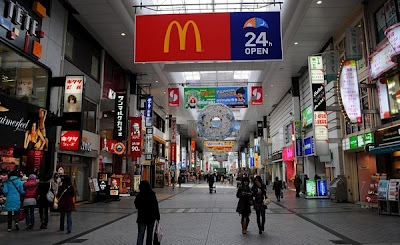
Downtown Kumamoto; images courtesy of Google
One thing that I was excited about was the densha. The densha is a streetcar system. I've ridden on it by now and it wasn't nearly as exciting as I thought it would be, but still, it's a streetcar! I ride in a streetcar to get around now! My first time on the densha, I was alone, so I had my English guide practically glued to my face. The lady who was making announcements about stops and watching the fare box was right in front of me, and since it was very clearly my first time she kept an eye out for me. I was touched that she kept checking to make sure I was okay. There is also a bus system, but it terrifies me, so unless I get very specific instructions I steer clear. There is no map for the busses in English, and, from what we've heard, it's confusing even if you do speak Japanese. Once I move into the JELA apartments I will have a bike, but until then I will walk most everywhere, which suits me fine.
Densha! And look you can see the castle in the background. Did I mention that Kumamoto has a castle? True fact.
We are kinda in this weird flux period of orientation. We won't actually start teaching until the start of the new school year, which for Japan is in April. Until then we are continuing our language studies, observing classes at the schools, and participating in church activities. Laura and Morgan with both be teaching at Luther Gakuin and I will be at Kyushu Gakuin. While I won't be the only native English speaker there, I will be the only J-3, which is unusual. Usually, both schools have three, from what I can tell.

Let me tell you a little about Kyushu Gakuin. First off, you should know, that my initial feeling is that I am going to love working there. I think that once I start I will settle in very quickly. At least I hope so. That being said, I was surprised by some things. Foremost in my mind is the fact that Kyu-Gaku, as it is known colloquially, was an all boys school until eight years ago. So that means that in the high school 80% of the students are male. The junior high is a little better. The staff is roughly the same. It is a very sports oriented school and several teams go to nationals every year. They are very well known for their baseball, track, and kendo teams. Kendo is the modern Japanese martial art of sword-fighting.
Kyu-Gaku front gates
The students are very energetic, to put it lightly. I was walking through the hall on our first day of orientation at Kyu-Gaku with Laura and Morgan and another English teacher when a big group of boys started jumping and chanting in their classroom. I swear to you the floor was shaking. It was this deep booming chant, the kind you might imagine you would hear at a military base or something. I couldn't help but laugh at my new-found situation. Well, at least I laughed once my nerves settled!

That afternoon the three of us went with an English teacher named Kotegawa-sensei, who is a graduate of Kyu-Gaku and has been teaching there for forty years, to his senior level, sports course, English class. In Japanese high schools students can choose courses, which are essentially like our majors in college. So it was a class of thirty to forty, eighteen-year-old, male, athletes. Kotegawa-sensei broke the class up into three groups and put one of us at each table for the boys to ask us questions. It was highly entertaining. Each group had unofficially elected one of the group to be their spokesperson. Some of the questions I got were:
"What is your favorite color?"
"Do you like sports?"
"Do you speak Japanese?"
"Do you have a boyfriend?"
"Do you like Japanese food?"
"Who is your favorite celebrity?"

Coming up with the questions involved a lot of whispering amongst themselves and then asking as well as they could, with others throwing out random English vocabulary to aid the speaker. They were actually far better at it than I think they realized. After every answer I gave (even saying "green" for favorite color), I was answered with a collective "Oooohhh...." before they would go back to whispering for their next question. Why the whispering, I have no idea; I couldn't understand a word.

Upon leaving I had received three offers to be my boyfriend, several "I love you's", and an autograph. I promptly had Christine (the J-3 who I will be taking over for) verify that it was indeed a name. She smiled and translated it for me as his name and the name of the college he will be attending. My name was written down the side. Laura, Morgan, and I were laughing the whole way home, both of them having received the same treatment. It was a lot of fun, but I could tell that, were I to actual teach a class like that, it would be a handful, to say the least. I have since been told I will never teach those classes. Those are left up to Kotegawa-sensei and the other male teachers.

I teach my first lesson on Thursday to a group of third-year junior high schoolers. The school is divided into three years in junior high (the equivalent of 7th, 8th, and 9th grades) and three years in high school. They are at the end of their year, since they will graduate in March, and have finished their textbook, so I am planning a fun lesson. Possibilities include One Direction (very popular here), slang, and movie clips.

I am really going to enjoy my time here. Culture shock is difficult (more on that specifically in my next post), but my overall first impression of Kumamoto is a good one. It doesn't totally feel like home yet. Oddly enough, I feel like I settled into Tokyo faster than I am settling into Kumamoto. I think part of that is the fact that I am not attached to a church yet, aside from the international service at Kumamoto Lutheran. Another part of it is the culture shock and so I shrug that aside. It hasn't helped that I have been sick for the past two weeks either. Once I actually start teaching, choose my church, and become a part of the community more things will start to fall into place. I hope!

One last note on Kumamoto. Remember the elderly lady I met outside the Daiso in my first week in Tokyo? The incident that helped remind me that God put me there and would take care of any language barriers? I've had two of those here and I will relate one of them to you now. 

On Thursday I was feeling well enough to get out of my apartment. I had quarantined myself for about a week at that point and was going a little stir crazy. On our bus rides to Luther Gakuin I had noticed a small shop called Tomi's Shortbread House and a sign noted that it sold British shortbread. Some of you may not know this about me, but I LOVE shortbread. I receive it yearly in my stocking and it is a great treat. I set course for the shop.

It is an adorable little place (I'll try to post a picture sometime), with a cheerful red door. I went in and it smelled wonderful! The shop was very small and the kitchen was in the back and to the side. All their shortbread is made there. A young woman, probably a little older than me came out and greeted me, all in Japanese, and handed me a basket. I made the slight mistake of returning her greeting in my limited Japanese and then telling her, also in Japanese, that I loved shortbread. She beamed at me, excited that I had addressed her in Japanese, and asked me a question. I had no idea what she said, but, luckily, telling her I had no idea what she said was in my limited Japanese vocabulary. She smiled and said, "I speak little English." I smiled back and said, "にほんごすこしはなします", essentially, "I speak a little Japanese", only with terrible grammar. I probably spelled it wrong just now too! So then we proceeded to have this whole discussion in a mangled mix of Japanese, English, and laughter about where I was from, how excited she was that I came to her shop, how excited I was that her shop existed, what I am doing in Kumamoto, and what our favorite types of shortbread were. We had an audience too, there were two other women there, and I think they were family of the lady I was talking too. I bought two bags of shortbread and left the shop with promises to return and I certainly will. I was beaming the whole way home. God knew that what I needed that day was good conversation and a little sweet shortbread, and that's exactly what He gave me. Just as He did with Tokyo, I am sure He will make this place home.

*Note: Aside from the pictures of the three of us at Morgan's, I mostly made off like a bandit with pictures from Google images which may or may not remain on my blog. I'll get my own I promise!

Sunday, January 20, 2013

Tokyo Times


As many of you already know, I have moved from Tokyo to Kumamoto. Kumamoto is both the city I live in and the prefecture on the island of Kyushu, which is the southernmost of the four big islands. I will be living here for the remainder of my time in Japan, so I thought I would post some of my reflections on my time in Tokyo.

Tokyo was intense. I had never been in a city so large. The population is roughly 32.5 million people, the largest city in the world. In comparison, New York City has "only" 19 million people. It definitely took some getting used to, and I am not yet convinced that I ever truly adjusted to having that many people around constantly. On the upside, I felt perfectly safe going out running at night because there were so many lights and so many people. I was never alone in Tokyo, save when I was in my apartment and even then I could hear people walking and biking four floors down. Or look across my balcony and see my neighbors working in their rooftop garden less than twenty feet from where I was standing. Or walk out my front door and stare right into my other neighbor's living room about ten feet from my face.

Our apartments were really close to Shinjuku Station, which is the busiest train station in the world with a total of four million people moving through it daily. The crazy thing is, those were our neighborhood stomping grounds. We were there almost every day, even if we were just passing through. It still boggles my mind that I became one of those four million commuters. Go to YouTube and type in "Tokyo rush hour, Shinjuku station" into the search. The amount of people is truly insane.

I felt so small in Tokyo. Like a little fish in a massive fish school. I was totally forgettable to those I crossed paths with, because you crossed paths with thousands of people every day. I was always wondering what their stories were and if we would ever cross paths again, and, if we did, would we know it?

The flip side of that was that I did make some very dear connections while in Tokyo. I have raved in this blog about my friends at Koishikawa Lutheran and I meant every word. I was terrified of church here in Japan and attending there certainly had its challenges, but truly, that church made Tokyo feel like home in a way that nothing else did. They accepted me from the very start and made me feel so comfortable, so welcomed, so utterly loved, with no reservations. It was there, for the first time, that God made me feel like Japan could be home. The idea that these people welcomed me into their hearts so readily without knowing really anything about me is a wonderful one and it makes me cry to remember it. I am sure that the congregation I have here in Kumamoto will be just as special to me, but Koishikawa was first and it will always hold that happy distinction in my heart. Here's to Tokuno-sensei and all the rest. I love you all dearly and cannot thank you enough for everything you did for me.

There were others in Tokyo that I made connections with outside of church. There are far too many to list, but I hope, if you're reading this, you know who you are. They say that home is where the heart is and that's true. Your heart is where the people you love are, so for that, the people were what made Tokyo home.

As for my literal home in Tokyo, I kinda miss it actually. We lived in the Sunnyside Court Apartments. Not sure where the name came from, there was no court or a whole lot of sun (except for my apartment! Cheers for being on the top floor!), due to the tall surrounding buildings built close together. Also, it was in Katakana, not English, but don't ask me to spell it; I'm not that advanced yet. I was on the fourth floor, Laura on the third, and Morgan on the second. We gathered in my room, because I was the lucky one who had TWO chairs instead of just one, AND a fold out table.

On our second to last night in Tokyo we gathered in my room to try our hand at ordering a pizza for delivery. Morgan had picked up three beers earlier for us to try and we decided after a hard day of packing to have a pizza and beer night to celebrate. I had received a text from our friend Hashi-san that he had a gift that he wanted to send with us to one of the Kumamoto J-3's and so I was waiting for his call to go meet him and pick it up. So when I got a phone call fifteen minutes after placing our order online (thank you Dominoes for the English menu and online ordering system), I assumed it was Hashi and picked up with a very cheery, "Hey!" It was not Hashi. It was someone speaking entirely in Japanese. I panicked before trying my most polite, "せみませんええごはなしますか?”"Excuse me, do you speak English?" He replied, "はい”"Yes" before continuing to talk to me in Japanese. I got the picture, that it was the delivery man here fifteen minutes before we expected him, and he wanted to be let in, or at least that was my guess, he was talking really fast, but he was the only person I could think would be calling me and speaking entirely in Japanese at 7:00 at night. So I grabbed my wallet and flew out the door after throwing my phone at Laura so that she could speak to him in Japanese. She followed me and five minutes later we were laughing too hard to really make it up the stairs. Poor guy. He had no idea what hit him when the two of us burst out the front door. We scarfed down the pepperoni pizza and toasted to our time in Tokyo... while watching Korean dramas. That story, I feel, is very representative of our time in Tokyo: language mishaps, running flat out, laughter, good food, good friends, crazy timing, Japanese lessons, attempts to find American food, Korean dramas, and blank stares (what the pizza guy got when he asked me something in Japanese before Laura got there).

Tokyo was a blast. Really, it was like an introductory course to Japan. It wasn't strenuous, there was no real job for us to do, save learn as much Japanese as possible (in my case it wasn't much) and get immersed in the culture here. Essentially, we spent two months as tourists. We ate out a lot. More than we probably should have. We went exploring frequently, though there are still places I wish we had gone. We found hidden gems and well known landmarks. I became brave about my inability to converse in Japanese and refused to let that stop me from trying to talk to people. We made connections with people from all walks of life and all ages. We had mishaps that became inside jokes and victories that led to more eating out in order to "celebrate". I feel that the three of us quickly established roles within our group and created a bond that will not be easily broken. Tokyo was our adjustment period and I am very thankful for it; now, our real work begins. Tokyo was the beginning of our adventure. Were this a novel, Tokyo would have been Part One and now we move on to Part Two. We have our setup, now the plot thickens!

Top Ten Favorite things about Tokyo: (in absolutely no particular order)
  1. Hotteok (the pancake/English muffin thing)
  2. Koishikawa Lutheran
  3. Edo-Tokyo museum (I learned so much! Have to go back!)
  4. blogging times at Tully's (though they never could make as good of a mocha as Snow Cup)
  5. Snow Cup
  6. Kamakura trip (not really in Tokyo, but we were living there when it happened so you know, it works)
  7. Korea Town
  8. my miniscule apartment
  9. Hongo bible study
  10. Tokyo friends (Miss you all!)
  11. lectures at the seminary

Okay so that's eleven and I really could keep going I am sure, but I will stop for now. Stay tuned for my initial thoughts on Kumamoto. Here's a teaser: "Will you... allow me... be your boyfriend?"
My apartment in Tokyo
So I literally just turned around from where I took the first picture to take this picture of  the  rest of my apartment.
The view from my balcony
See, I really was there! It was a cute little place, just the right size for just me.
Tokyo night view: picture taken at Tokyo Tower
Tokyo Tower
Some of my dear Koishikawa people

With friends in Odaiba, a large man-made island outside of  Tokyo. The robot is  called a Gundam, though I'll be honest I have no idea what that means... sorry nerd friends!
Also in Odaiba - we are waiting for fireworks here and absolutely freezing! But the fireworks were worth the wait.
In Kamakura, one of the ancient capitals of Japan. Behind is the Great Buddha. It is made of bronze and was cast in 1252. It has withstood typhoons and tsunamis; very impressive and demanding of respect.
With friends headed to Tokyo Tower! It was a trick taking that picture I must say.

My going away party with Koishikawa - Tokuno-sensei took me to a "drinking  house" to experience more Japanese culture :) So sad to be parting!